Thursday, 15 October 2020

Notifications ceasing soon Please resubscribe on new Blog

Hello Adjangst subscribers

Just letting you know that notifications from this blog will cease at the end of October

If you want to continue to be notified of new posts please go to Wordly Explorations and add your details to the Follow by email box. It's 100% private and secure and not used for any other purposes.

Wordly Explorations loves subscribers too!


Friday, 9 October 2020

New post on Wordly Explorations - Enough

Hello AdjAngst readers

There's a new post on Wordly Explorations: Enough - when enuf isn't enauph. Check it out here.

If the link above doesn't work, cut and paste this text into your browser: https://wordlyexplorations.blogspot.com/2020/10/enough-when-enuf-isnt-enauph.html

And while you're there, don't forget to subscribe to receive notifications of new content directly from Wordly Explorations.

Monday, 28 September 2020

New on Wordly Explorations: The market - a solution to what? Part 2

Hello AdjAngst readers

There's a new post on Wordly Explorations: The market - a solution to what? Part 2 Check it out here.

If the link above doesn't work, cut and paste this text into your browser: https://wordlyexplorations.blogspot.com/2020/09/the-market-solution-to-what-part-2.html

And while you're there, don't forget to subscribe to receive notifications of new content directly from Wordly Explorations.


Thursday, 17 September 2020

From Mark Twain

Hello AdjAngst readers

There's a new post on Wordly Explorations: Wordly Inspiration from Mark Twain. Check it out here.

And while you're there, don't forget to subscribe to receive notifications of new content directly from the new site.

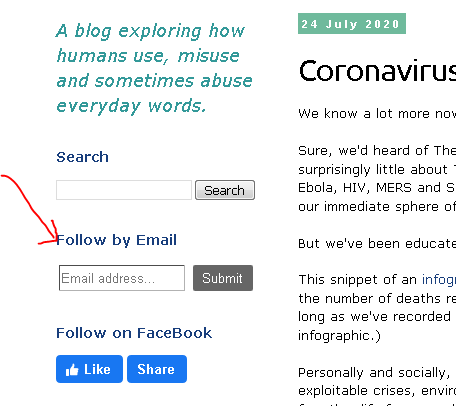
When you open Wordly Explorations, you can add your email address in the box shown at the arrow; and I'll remove you from this mailing list. 


Thursday, 10 September 2020

The market - a solution to what?

Hello AdjAngst readers

There's a new post on the new blog: The market - a solution to what? Check it out here.

If the link above doesn't work, cut and paste this text into your browser: https://wordlyexplorations.blogspot.com/2020/09/the-market-solution-to-what.html

And while you're there, don't forget to subscribe to receive notifications of new content from Wordly Explorations.

Thursday, 3 September 2020

TATKOP 126

There Are Two Kinds Of People: those who 'want it fixed now!' and those who know there is no 'fix' to many problems. (I've worked for some of the former!)

those who 'want it fixed right now' and those who know there is no 'fix' to many problems


If you haven't subscribed to the new blog yet, you can do it here: Wordly Explorations. Submit your preferred address to receive an email one a week with a new post - two articles per month and two shorter sayings or a TATKOP. You will receive a confirmation email soon after; click the link and you're set! 

screen shot with arrow to Follow by Email


Posts on AdjAngst will be ending soon!! (For a short time you may receive notifications from both AdjAngst and Wordly Explorations. Apologies for any duplication.)

Thursday, 27 August 2020

The new blog is here!

Well 2020 has been a year! As you all know. My intended  revision, redesign and migration to a new blog took twice as long as anticipated, but... finally...  

The exciting news: announcing WORDLY EXPLORATIONS!


Here's the new blog design.

screen shot of Wordly Explorations blog home page


The good news


Wordly Explorations is everything you enjoyed about AdjAngst with an expanded set of topics. The new design makes it easier to read, and the font is larger (thanks for that feedback). It is a responsive site, so it should be better on devices too. Other feedback to enhance readability has also been integrated, so I do hope you enjoy. 

Probably the biggest change is that I am now (mainly) writing under my own name. That feels like a big step!

The bad news

screen shot from website showing where to subscribe to follow by email

I can't migrate the email subscribers from AdjAngst over to Wordly Explorations, so you will need to resubscribe to continue to receive weekly posts. I'll keep AdjAngst going for a while yet, with cross links to the new blog, so you have some time to resubscribe. 

You'll find the Follow by Email option on the left of every Wordly Explorations page (at the red arrow in this image).

I was able to migrate the AdjAngst Facebook community page over to Wordly Explorations, so if you follow the blog on Facebook, you don't have to do anything. 

And finally, MORE good news: the Wordly Explorations manifesto


I am really excited about starting a new phase of writing and exploring words. I look forward to your comments, feedback and company as we explore the everyday words we humans use, misuse and sometimes abuse.


Thursday, 13 August 2020

From Mary Pipher

 Wordly Inspiration from Mary Pipher, the author of Writing to Change the World:

"A writer's job is to tell stories that connect readers to all the people on earth, to show these people as the complicated human beings they really are, with histories, families, emotions, and legitimate needs. We can replace one-dimensional stereotypes with multidimensional individuals with whom our readers can identify."

Thursday, 6 August 2020

TATKOP 125

There Are Two Kinds Of People: those who blame others and those who blame themselves.  

Is there a third: those who don't use blame as a way of understanding other people and the world?

those who blame others and those who blame themselves.


See more in the TATKOP series.


Thursday, 23 July 2020

Coronavirus - a story of semantic boundaries

We know a lot more now about pandemics than we used to.

Sure, we'd heard of The Plague - the big one in terms of numbers of deaths and social impact back in the 1300s. We know surprisingly little about The Spanish flu despite its global devastation one hundred years ago. Maybe we saw reports on Ebola, HIV, MERS and SARS; but they happened somewhere else to other people. They were managed and stayed outside our immediate sphere of concern. 

Infographic of human pandemics see alt text at source
See full infographic at Visual Capitalist
But we've been educated recently. 

This snippet of an infographic from Visual Capitalist with disturbing fluffy things as the number of deaths reminds us we have had pandemics and plagues for at least as long as we've recorded human history. (It's worth a look at the full infographic.)

Personally and socially, pandemics and plagues are devastating, politically they are exploitable crises, environmentally they are warning bells about humanity's disregard for other life forms, and existentially they refuse our preference to ignore our mortality. 

But semantically they are all over the place. 

The naming of pandemics, including the coronavirus, is an intriguing story.

It's a story of semantic boundaries (try singing it to the Brady Bunch theme).

Thursday, 16 July 2020

From Jorge Luis Borges

Wordly Inspiration from the brilliant and irreverent Jorge Luis Borges:
It is often forgotten that [dictionaries] are artificial repositories, put together well after the languages they define. The roots of language are irrational and of a magical nature.


Monday, 13 July 2020

Quiet - lauding the disengaged

Dismissing those who complain seems to be an Australian pastime. 

We sure have a lot of words for it: whinging poms, elitist ingrates, dole-bludgers, anti-jobs activists, professional troublemakers, idiot protestors who block the streets and make life difficult for everyone else. 

In contrast, the fabled Australian character is stoic, no-nonsense, easy going, just get it done, uncomplaining. Don't make a fuss, don't whinge, and don't - whatever you do - get involved in protests.

This fabled character recently resurfaced in Australian politics. In May 2019, Scott Morrison attributed his unexpected election victory to 'the Quiet Australians who have won a great victory tonight'. 

I wondered who these quiet Australians were and if I knew any of them; they're the majority judging by the political outcome.


If we go by the dictionary, a quiet Australian is: 

 marked by little or no motion or activity, gentle, easy going

 free from noise or uproar, unobtrusive, conservative taste 

So, are the Quiet Australians minimally active, gentle, easy-going, quiet, calm, unobtrusive people with conservative taste in clothing and food? Don't they even occasionally yell at their children?

Well no, the word quiet means something much more insidious in politics. 


Thursday, 2 July 2020

TATKOP 124

There Are Two Kinds Of People: those who illuminate reality and those who obscure it.

 TATKOP: those who illuminate reality and those who obscure it.

See more in the TATKOP series.


Sunday, 28 June 2020

Diversity 2 - comfort, power and counting

By Fred Shivvin

In part 1, I explored the word diverse which means 'various or assorted' and what sits behind the misuse of diverse to mean 'different from me'.


Learning to value diversity in humanity involves positive interactions with a variety of people.


However, some individuals never have this experience. With their limited interactions, they can grow up to think people 'like me' (according to sex, race, economic status, ability, etc.) are 'us', and anyone 'different from me' is 'them' or 'the other'. 


The two mind maps in part 1 explained that these individuals see their 'self' as the 'default human' and the 'other' as a lesser human.


We have to be as clear headed about humanity as possible, after all we are each others only hope
The idea that any person could claim to be the 'default human' is patently ludicrous but it operates subconsciously, deep below our awareness (except for white supremacists and others who promote this idea).

It is far from clear-headed and it spawns unfairness and injustice in the forms of racism, sexism, ableism etc.


How can some people never experience a real challenge to such a distorted view of the world that they are the 'default human'?


Thursday, 18 June 2020

From Isaac Asimov

Wordly Inspiration from Isaac Asimov, who has long inspired me to write:
Writing, to me, is simply thinking through my fingers. 


Friday, 12 June 2020

Diversity - defeated by the default

By Fred Shivvin


Diversity (likewise inclusion) is a word I hear frequently. Diversity appears in technology, education, the arts, music, and science, sometimes accompanied by 'diversity' targets. We hear about the diversity of culture and opinion in Australia. Many companies have Diversity and Inclusion Divisions equipped with KPIs for their annual reports.


Welcome graphics of different people
The driver for diversity is fairness. It entails welcoming all people, ensuring decision-making groups are representative of the broader society, and more people can participate in a greater range of life's opportunities.

But I think diversity and its adjective diverse are most often just buzz words: they make a 'buzz', but they communicate little (likewise inclusion and inclusive).


The word diversity should convey an important idea: diversity is a positive characteristic of societies and groups. But the word has been emptied of this idea in many uses. This has happened through a subtle linguistic 'shift' to use diverse to describe individual people, usually meaning a person from a minority group.


Is this just a normal change in meaning? Is it just the all too common loss of a useful word? (I've written previously about accepting that words can change meaning over time, even really useful words, see Alternate grief.)


Or is there something else going on here? Has this subtle linguistic 'shift' been engineered? Is this way of using the word diverse working to keep people out?

Thursday, 4 June 2020

TATKOP 123

There Are Two Kinds Of People: those who know democracy is messy and those who want their leaders to keep things clean and tidy. 

See more in the TATKOP series.


Thursday, 21 May 2020

Uncertain 2 - our costly false comforts

By Mike Lundy

In the first part of this post, Uncertain about these uncertain times, I explored a contradiction at the centre of our humanity: wanting to be certain in an uncertain world.

Humans do whatever we can to avoid acknowledging the inherent uncertainty in our lives: cocooning ourselves in safe enclosures, limiting our lives, or planning obsessively to control the future.

We equate 'uncertain' with 'unsafe', to which our primal reaction is to run or make things safe again.

Our response when we perceive danger is emotional and compelling. Only rarely are our actions driven by an objective or factual assessment of information. We can even feel fear of imagined dangers, even when there is no imminent threat. Being told there really is no monster under the bed does not necessarily soothe our fear, and we continue to seek reassurance. We need to feel safe.

We do the same with the inherent uncertainty of life. The driver of our actions is emotion: we want a FEELING of certainty and safety. We want to FEEL reassured that things are certain and safe.

This means we are extremely vulnerable to any information that stirs our feelings of uncertainty and insecurity, regardless of actual threats, or to people who promise us certainty and safety in the face of real, imagined and even concocted threats.

Perversely, the emotional comfort of 'false' certainty is often more compelling than any facts of certainty and safety.

Every successful politician, marketing executive, con artist and cult leader knows this. And they exploit us with this knowledge.

Part 2 looks at the implications of our need to feel things are certain, and therefore safe, and what false promises we will happily accept in order not to feel the fear of uncertainty.

Thursday, 14 May 2020

Why bother?

Wordly Inspiration (source unknown): it may be a wound, it may be a hunger, it may be a question, but writing is always worth the bother.

text from a page with parts missing: Because right now, there is... someone... out there with .... a wound... in the exact shape.... of your words.


Friday, 8 May 2020

Uncertain about these uncertain times

By Mike Lundy

We are living in uncertain times.

Many of us feel very unsettled, even in the relative safety of Australia. When we are not searching out the latest pandemic news, we are flooding social media with our struggle to find focus or positivity, or we are comforting ourselves with nostalgia on travel, books and music, getting into gardening and busy work.

I sure feel a greater sense of uncertainty than I did this time last year.

The words: 'these uncertain times' are everywhere - news stories, ministerial announcements, articles on physical and mental health, reports, and advertisements for everything from cleaning products to insurance to dating apps. Some go so far as to call our times 'an era of uncertainty'. (Here's an Australian example from 2018.) An American report published in 2004, told us to expect that 2020 would be characterised by a 'pervasive sense of insecurityrelated to concerns over job security, fears around migration, terrorism and internal conflicts, and military conflicts .

No prediction of a global pandemic though, the latest source of the ubiquitous statement that we are 'living in uncertain times'.

Try searching Google's library of digitised manuscripts for the phrase 'these uncertain times', and you'll find that it occurs over and over, in hundreds of journals and books, in virtually every decade the database encompasses, reaching back to the seventeenth century.But are 'these times' truly more uncertain than other times? 

Interestingly, Oliver Burkeman says that every era describes itself as characterised by unprecedented uncertainties and lack of stability. 

Just a few of his examples:
 In 1951, Alan Watt highlighted a contemporary 'feeling that we live in a time of unusual insecurity'… referring to the impact of the breakdown of long-established family, social, economic  and belief traditions.
Writing about the Roman Republic and Empire over three centuries is replete with political instability and social unrest and the impact on people who felt their future was disturbingly uncertain.
The idea that earlier times were more certain and stable than our own experience of life is really nostalgia, based on an imagined and idealised past.

In fact, when you're fully engrossed in living your own life, you face uncertainty all the time.

Because life is irrevocably, constantly and most certainly uncertain. 

The global pandemic reveals a fundamental truth: we humans are deeply deluded that we are fully in control of ourselves, our future, our world. We desperately want to believe we can make our lives certain, set and fixed. 

Recent posts